English
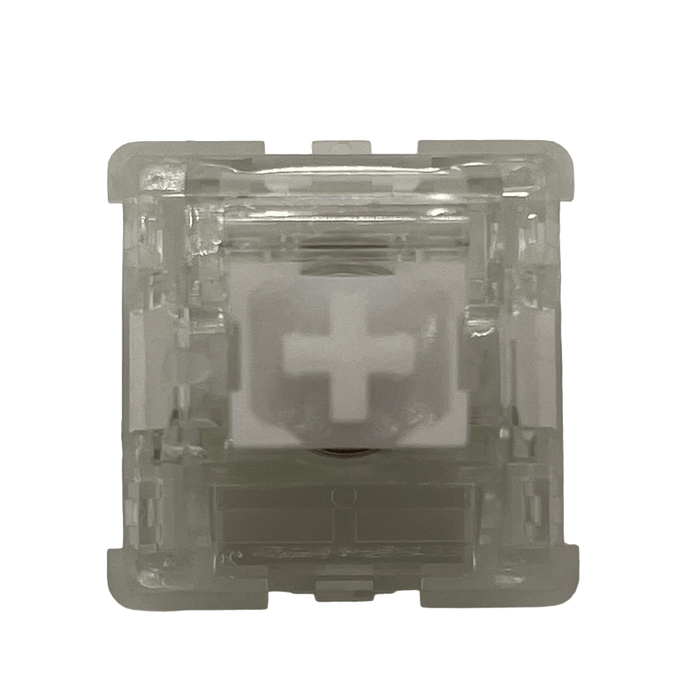
Haimu Snow Silent HE Magnetic Switch – Ultra-Silent, Magnetic and Ultra-Smooth

The Haimu Snow Silent HE Magnetic Switch is not a “regular” mechanical switch, but a Hall Effect (HE) linear. That means input is detected through a magnet + sensor instead of metal contact points. In practice, this mainly gives you three benefits: more consistency, more adjustability, and less noise.
This switch is especially interesting for people who want a quiet setup without sacrificing control—think office work, shared spaces, or late-night gaming.
Quick answer (if you want to choose fast)
Want maximum silence and adjustable actuation on an HE keyboard? Then the Haimu Snow Silent HE is a top pick. Using a normal MX keyboard? Then this switch is not compatible.
1. What does HE actually mean (in plain language)?
- Hall Effect (HE): the key registers via a magnetic field, not through physical metal contact.
- Why this matters: less variation in registration, less classic contact wear, and often adjustable actuation via software.
- Actuation point: how far you press before a keystroke is registered (on HE boards, often adjustable per key).
- Rapid Trigger: on supported keyboards, the key can reset faster for quick repeated inputs.
2. Specifications with practical explanation
- Type: Silent Linear (Hall Effect / magnetic)
- Actuation: magnetically measured (adjustable on compatible HE boards)
- Total travel: approx. 4.0 mm
- Noise level: very quiet thanks to internal dampening
- Materials: nylon housing, POM stem, magnetic system
- Wear profile: no classic electrical contact-wear point like traditional contact-leaf switching
Important: “virtually unlimited” is often used as marketing language. In reality, parts can still age over time, but contact wear is clearly less of a factor than with classic contact switches.
3. How does it feel in use?
- Press feel: linear and very consistent, without a tactile bump.
- Travel feel: smooth and calm, with little mechanical “noise” in the keystroke feel.
- Bottom-out/top-out: strongly damped, so less hard ticking at the start/end of the stroke.
- Consistency: especially strong during rapid repeats and long sessions due to stable registration behavior.
4. Sound: why is it so quiet?
The low noise level comes from a combination of silent dampening (less impact noise) and how HE boards detect input. You therefore hear less mechanical “tick” and get a softer, more controlled keypress.
- Traditional linear: usually more audible top-out/bottom-out.
- Haimu Snow Silent HE: much less impact noise, especially pleasant in quiet spaces.
5. Who is it for / not for?
A good match if you:
- want to type or game quietly;
- like to fine-tune actuation in software;
- want a tight, linear feel without tactile feedback;
- already have an HE-compatible keyboard (or plan to get one intentionally).
Less suitable if you:
- use a standard MX hot-swap board without HE support;
- specifically want a clear tactile bump/feedback;
- want a pronounced “thock/clack” sound-focused build.
6. Comparison in context
| Switch | Technology | Noise level | Feel | Key strength |
|---|---|---|---|---|
| Haimu Snow Silent HE | Hall Effect (magnetic) | Extremely quiet | Ultra-smooth, linear | Silence + adjustability |
| Cherry MX Silent Red | Classic mechanical | Quiet | Soft, damped | Broad compatibility |
| Gateron Silent Yellow | Classic mechanical | Quiet | Linear with light dampening | Accessible all-rounder |
7. Practical buying tip (most important check)
Always verify first whether your keyboard supports HE/magnetic switches. A standard MX hot-swap PCB is usually not enough for HE switches.
Conclusion
Haimu Snow Silent HE is strongest when you want a quiet, modern, and adjustable typing experience on a compatible HE platform. You get a very smooth linear feel, low noise, and strong control over actuation settings. Want maximum silence + precision? Then this is a very strong option. If you use a normal MX board or prefer tactile feedback, a classic silent switch is often the better fit.
Also check our full Switch Collection at RGBKeys for linear, tactile, silent, and HE options.
Products from this article
View the products mentioned in this blog.